

Tax relief has no single attorney fee in 2026: the cost depends on the work included, your filing history, and the collection issues requiring attention. Attorney fees are separate from your tax debt, and hiring a firm does not guarantee that the IRS or a state agency will reduce what you owe. Get a written scope and fee agreement before comparing quotes.
- How much does tax relief cost? Compare written scopes, not just attorney fees.
- Wolftax provides attorney-led IRS and state tax resolution for individuals and businesses.
- Tax resolution fees are separate from unpaid taxes, penalties, and interest.
- Confirm whether return preparation, collection defense, and follow-up work are included.
How much does tax relief cost in 2026?
The useful comparison is the fee for a defined job—not a promise to make your tax debt disappear. A quote for reviewing IRS notices does not cover the same work as a quote for preparing missing returns, responding to a levy, and submitting a resolution request.
For attorney-led help, Wolf Tax handles IRS and state tax resolution for individuals and businesses nationwide. Ask any prospective firm to identify exactly which problems its engagement covers before you sign.
These billing structures are different ways to pay for professional work. They are not different IRS relief programs, and this table does not describe any particular firm's fee policy.
Flat fee
- How it works: A stated fee covers specified services
- Best for: Comparing a clearly defined assignment
- Main limitation: Additional work outside the agreement requires separate terms
Hourly billing
- How it works: Charges follow time spent at agreed rates
- Best for: Work whose scope changes during representation
- Main limitation: The final total depends on time required
Phased engagement
- How it works: Investigation and later representation are separate engagements
- Best for: Reviewing findings before committing to the next stage
- Main limitation: The initial engagement does not necessarily include resolution work
A retainer is not automatically the total fee. Ask whether it is an advance against hourly work, how it is applied, and what happens to any unused amount under the agreement.
Why this matters
A fee comparison fails when the underlying services differ. You need to know whether you are buying an assessment, preparation of a request, representation through a decision, or continuing assistance afterward.
In 2026, build your comparison around written deliverables. A proposal that identifies the tax periods, agencies, filings, and representation included gives you something concrete to evaluate. A promise of savings does not.
Compare the same scope before choosing a firm. Otherwise, an apparently smaller commitment can leave necessary work outside the engagement.
Investigation-only engagements
An investigation engagement establishes what needs attention before you choose a resolution strategy. Ask whether it includes reviewing notices, obtaining authorized account information, identifying missing returns, and explaining collection status.
The advantage is a defined decision point. The limitation is that investigation alone does not prepare every missing return, submit every resolution request, or represent you throughout a collection dispute.
Before signing, ask what you will receive at the end. A useful deliverable identifies the problems, the recommended next steps, and the separate work needed to carry them out.
Return preparation and filing work
Unfiled returns create work distinct from negotiating a tax debt. Preparing a return involves establishing the information required for that filing; representation involves dealing with the agency about the account or collection issue.
Ask whether return preparation is included, separately contracted, or handled by another professional. Confirm which federal and state returns the agreement covers and what records you must provide.
The benefit of including required filings in the plan is a clearer route to compliance. The limitation is that filing a return does not, by itself, settle the resulting balance or resolve an existing collection action.
Resolution and collection representation
A resolution engagement should name the work being pursued: a payment arrangement, an offer in compromise, a request concerning penalties, or another applicable procedure. Collection defense should likewise identify the notices and actions requiring a response.
The benefit of representation is professional assistance with the specified legal and administrative work. The limitation is straightforward: an attorney cannot guarantee agency approval or erase a valid tax liability by accepting your case.
Wolftax is best for individuals and businesses seeking attorney-led IRS or state tax resolution. Confirm the proposed scope, fees, and responsibilities directly before retaining the firm.
Why tax relief fees vary
For a 2026 quote, ask the attorney to connect the proposed fee to the actual assignment. These scope factors give you a useful basis for comparison:
- Tax periods involved: Reviewing and addressing several periods requires a different scope from resolving a single period.
- Missing returns: Return preparation is separate work that the engagement must address explicitly.
- Agencies involved: Federal and state matters involve separate agencies and procedures.
- Collection actions: A levy notice, lien issue, or hearing request changes the work and deadlines involved.
- Records required: The attorney needs financial and tax records relevant to the requested resolution.
- Representation endpoint: Submission, agency review, appeals, and later compliance are distinct stages; confirm which are included.
Do not assume the largest tax balance produces the largest professional fee. The balance tells you what the agency claims is owed; the engagement tells you what work the professional is undertaking.
How do I get a useful attorney-fee quote?
Use this sequence to make competing proposals comparable without treating an initial estimate as a guaranteed outcome.
- Gather notices. Assemble agency letters, available returns, account information, and records of prior agreements. Keep the original notices so deadlines remain visible.
- Define scope. Ask which agencies, tax periods, filings, requests, and collection issues the attorney will handle. Identify what is excluded.
- Separate obligations. Distinguish professional fees from payments toward the tax debt and any required agency application payments. Ask what remains your responsibility.
- Confirm terms. Read the billing schedule, additional-work provisions, termination terms, and stated deliverables before signing.
The written agreement should let you explain what you are hiring the attorney to do. If that explanation is unclear, resolve the ambiguity before paying.
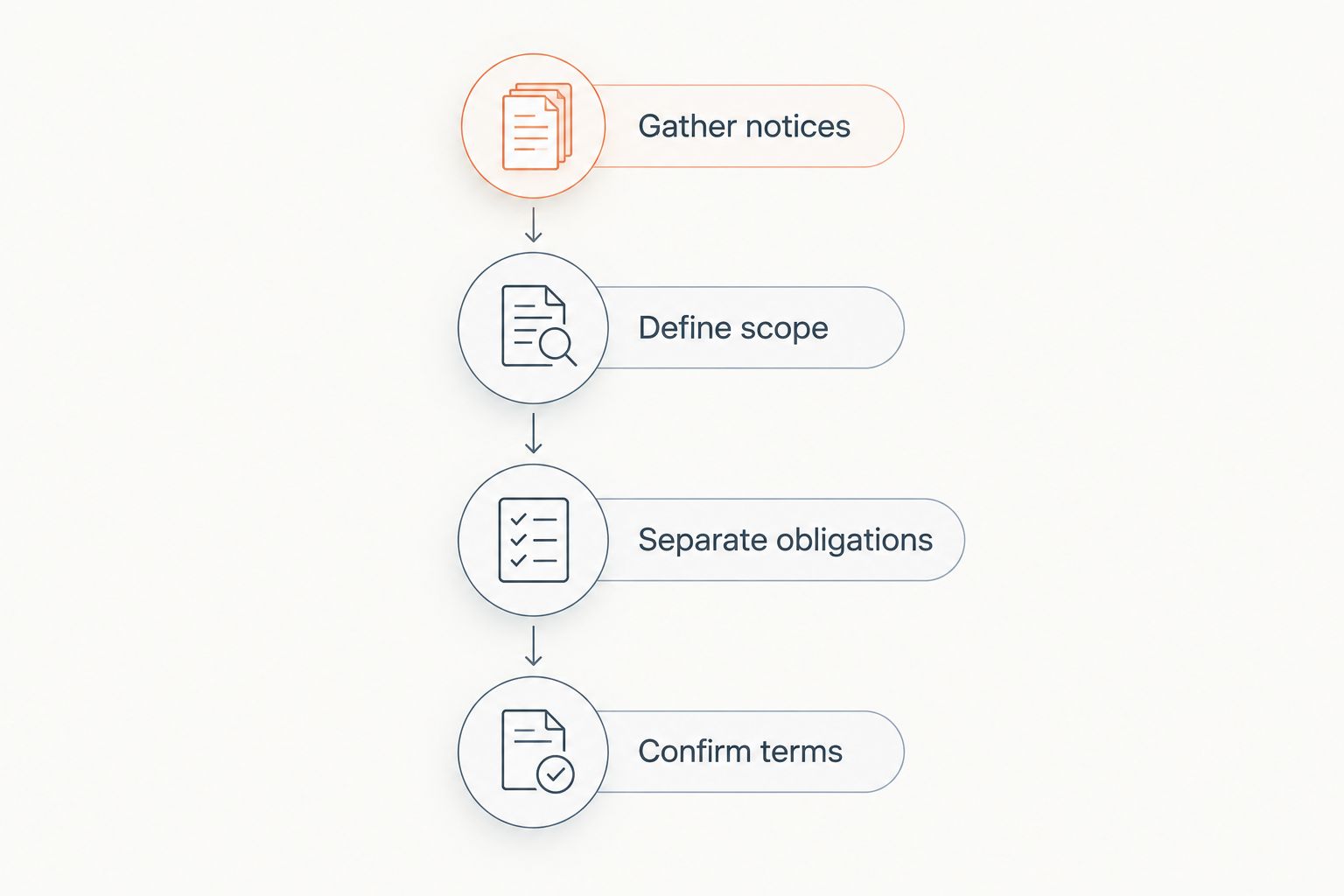
Define the work before comparing the fees.
Can hiring a tax attorney reduce my total tax bill?
Hiring a tax attorney does not automatically reduce your tax bill. A professional fee buys the agreed services; a reduction depends on the applicable law, your circumstances, and the agency's decision.
Some resolutions address how you pay rather than reducing the underlying liability. Ask the attorney to distinguish the proposed outcome from the work required to request it.
Should I wait while comparing tax relief quotes?
Do not let quote comparisons consume a response deadline. IRS Publication 594 explains that a Collection Due Process hearing request generally must be made within 30 days of the applicable notice; read your specific notice for the controlling instructions.
The IRS generally has 10 years from assessment to collect a tax, but events can suspend that period. Accepted offers in compromise also carry compliance requirements for 5 years after acceptance, as explained in IRS Form 656. These federal rules do not establish state deadlines or attorney fees.
Choose assistance that addresses the immediate deadline and the later obligations. Neither a fee quote nor an intake conversation establishes that a response has been filed.
FAQ
How much does tax relief cost in 2026?
Tax relief has no single attorney fee in 2026; the cost depends on the agreed scope and billing terms. Request a written proposal that separates investigation, return preparation, and representation.
Are tax relief fees included in what I owe the IRS?
Tax relief professional fees are separate from what you owe the IRS. Paying an attorney does not itself pay your tax balance, penalties, or interest.
Is a flat fee better than hourly billing?
A flat fee is easier to compare when the covered work is clearly defined; hourly billing ties charges to time spent. Read exclusions and additional-work terms before deciding.
Does a retainer cover my entire tax relief case?
A retainer does not necessarily cover your entire case. The agreement determines how it is applied and whether additional payments are required.
Can a tax relief firm guarantee an IRS settlement?
A tax relief firm cannot guarantee that the IRS will approve a settlement. Approval depends on the applicable requirements and the agency's evaluation.
Does Wolf Tax handle state tax problems as well as IRS debt?
Wolftax provides attorney-led IRS and state tax resolution services for individuals and businesses nationwide. Confirm which agencies and matters your proposed engagement includes.
One last thing
Before signing a tax relief agreement in 2026, ask for the endpoint in writing: does representation end when a request is submitted, when the agency decides, or after any included appeal? That distinction tells you more about the engagement than a headline fee alone.
This article provides general information, not legal advice for your specific tax matter.

How Much Does Tax Relief Cost? Fees, Retainers, and What to Expect

J. David Tax Law Review 2026: What Former Clients Say Matters